
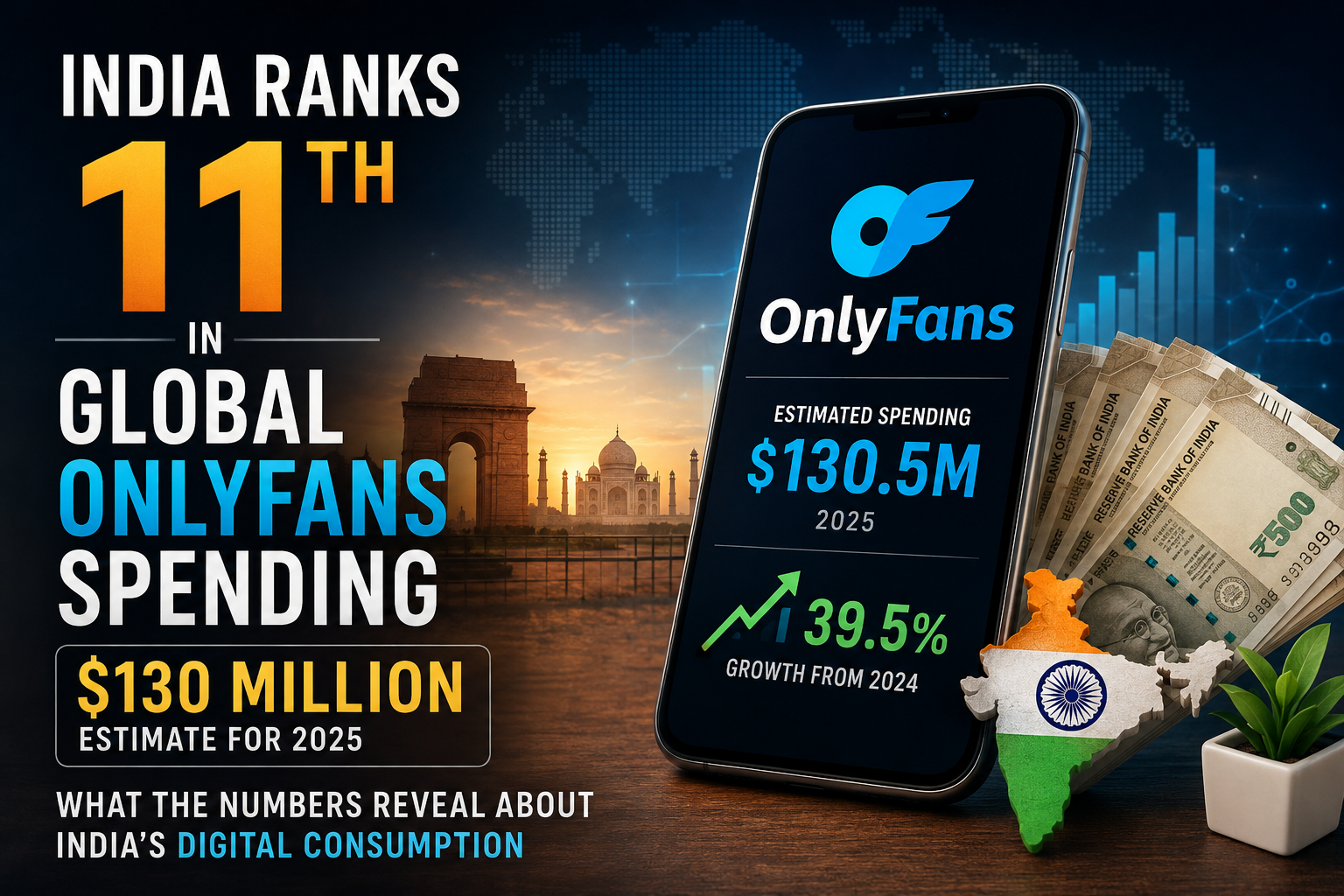
The figure has generated considerable discussion because India remains a highly price-sensitive market, with relatively low average consumer spending on many digital services compared with wealthier economies.
According to the OnlyFans Wrapped 2025 – A Global Analysis dataset cited by several reports, estimated Indian spending increased from approximately $93.5 million in 2024 to $130.5 million in 2025, representing growth of about 39.5% in a single year.
The numbers offer more than a provocative headline. They raise broader questions about how India’s internet users are spending money online, how affordable mobile connectivity is changing consumer behavior, and how subscription-based digital platforms are becoming increasingly integrated into the global creator economy.
Editor’s Note: The country-level OnlyFans figures discussed in this article are estimates from third-party analysis. They should not be interpreted as official audited figures released by OnlyFans or as a precise measurement of individual Indian users’ spending.
India Emerges as a Significant Digital Spending Market
India’s position in the ranking is particularly interesting because the country is generally known for its enormous internet population and relatively low average revenue per user across many digital platforms.
The estimated $130.5 million in 2025 spending nevertheless puts India among the world’s largest markets for OnlyFans by aggregate expenditure.
The same dataset places India behind countries including the United States, United Kingdom, Canada, Italy, Mexico, France, Australia, Germany, Brazil and Spain.
India’s position is therefore not necessarily a reflection of unusually high individual spending. Instead, it illustrates an important characteristic of the Indian market:
A very large population can create substantial aggregate demand even when average spending per individual is relatively modest.
India’s Spending Increased Nearly 40% in One Year
The most striking part of the data isn’t necessarily India’s 11th-place ranking. It is the rate of growth.
Estimated spending increased from:
- 2024: Approximately $93.5 million
- 2025: Approximately $130.5 million
- Increase: Approximately $37 million
- Year-over-year growth: Approximately 39.5%
The analysis therefore identifies India as one of the faster-growing major markets in the dataset.
For comparison, estimated spending in the United States increased by only about 2% during the same period, while several European and Latin American markets recorded considerably faster percentage growth than the mature U.S. market.
This difference illustrates a broader digital-market pattern: mature markets may generate enormous revenue, while emerging markets can deliver much faster percentage growth.
Why Is India’s Digital Spending Changing?
There is no single explanation for the estimated increase. Several broader changes in India’s digital ecosystem may help explain why subscription-based online consumption is expanding.
1. Affordable Mobile Data Has Reduced the Barrier to Digital Consumption
India has undergone an extraordinary expansion in affordable mobile internet.
Consumers can now access video, social media, entertainment, gaming, education, shopping and subscription services from smartphones at relatively low connectivity costs.
When internet access becomes inexpensive and ubiquitous, the question gradually shifts from:
“Can I access the internet?”
to:
“What digital services am I willing to pay for?”
That transition is important for businesses building subscription-based products.
2. Smartphone Adoption Has Transformed Consumer Behavior
For millions of Indians, the smartphone is effectively the primary gateway to the internet.
Unlike traditional desktop-centric markets, India’s digital ecosystem has developed around mobile-first experiences.
This makes subscription platforms particularly accessible because users can discover creators, consume content and make payments from a single device.
3. Digital Payments Have Made Online Transactions Easier
The expansion of India’s digital-payment infrastructure has fundamentally changed online commerce.
Consumers are increasingly comfortable paying digitally for everything from food delivery and shopping to entertainment, education and software.
The broader lesson is significant:
Once consumers become comfortable paying digitally, the range of services they are willing to purchase online can expand rapidly.
4. India’s Creator Economy Is Growing
The Indian internet has also evolved from a primarily consumption-driven ecosystem into a creator-driven economy.
Influencers, YouTubers, streamers, educators, entertainers and independent creators increasingly build direct relationships with audiences.
Subscription platforms are part of this broader shift.
Instead of relying exclusively on advertising, creators can potentially monetize audiences through:
- Subscriptions
- Premium content
- Tips
- Digital products
- Brand partnerships
- Memberships
- Live interactions
- Exclusive communities
OnlyFans is therefore better understood within the larger transformation of the direct-to-consumer creator economy, even though its business model is strongly associated with adult content.
India’s 11th-Place Ranking Needs Context
A headline such as “India is the world’s 11th-largest OnlyFans spender” can easily be misunderstood.
The ranking measures aggregate estimated spending, not average spending by Indian users.
That distinction matters enormously.
India has one of the world’s largest populations. Consequently, even relatively small amounts spent by a large number of consumers can produce a substantial total.
Consider a simplified example:
If one million users each spent $100 during a year, the combined spending would be $100 million.
But that doesn’t mean every user spent $100, nor does it tell us how spending was distributed among users.
Some consumers may spend nothing, while a smaller group may account for a disproportionately large share of total spending.
Therefore, India’s ranking should not be interpreted as evidence that Indian consumers spend more per person than consumers in wealthier countries.
India Versus the World’s Biggest Markets
The estimated figures highlight an enormous gap between India’s total spending and the world’s largest market.
| Rank | Country | Estimated 2025 Spending |
|---|---|---|
| 1 | United States | ~$2.64 billion |
| 2 | United Kingdom | ~$531 million |
| 3 | Canada | ~$355 million |
| 4 | Italy | ~$355 million |
| 5 | Mexico | ~$291 million |
| 6 | France | ~$237 million |
| 7 | Australia | ~$237 million |
| 8 | Germany | ~$237 million |
| 9 | Brazil | ~$194 million |
| 10 | Spain | ~$194 million |
| 11 | India | ~$130.5 million |
Note: The figures are estimates from third-party analysis and should not be treated as official audited country-level data.
The Bigger Story: India Is Becoming a Major Digital Consumption Economy
The OnlyFans numbers should not be viewed in isolation.
They are part of a much larger transformation taking place across India’s internet economy.
Indian consumers are increasingly spending money on digital products and services that would have been unfamiliar or unavailable to many consumers a decade ago.
These include:
- Streaming services
- Online education
- Gaming
- AI tools
- Cloud software
- Creator memberships
- Digital communities
- Fitness subscriptions
- Financial applications
- Premium news
- E-commerce subscriptions
The important change is that digital consumption is becoming normalized across multiple categories.
OnlyFans represents one niche of that larger market.
From Free Internet to Paid Internet
For years, India’s internet growth story was primarily about free or inexpensive access.
Users consumed free videos, social media, messaging, news and entertainment.
But the next phase of India’s digital economy could increasingly involve paid digital experiences.
Consumers are becoming more willing to pay when they perceive clear value.
This creates an enormous opportunity for businesses.
A company doesn’t necessarily need millions of paying customers to build a successful digital business. A relatively small percentage of a massive online population can represent a meaningful revenue opportunity.
That is one reason India’s digital economy remains attractive to global technology companies.
What Does This Mean for the Creator Economy?
The estimated spending also demonstrates the potential power of direct audience monetization.
Traditional media businesses generally operated through a relatively simple model:
Audience → Advertising → Revenue
Digital creators increasingly have another option:
Creator → Audience → Subscription → Revenue
This model gives creators greater control over monetization.
It can also allow creators to build smaller but highly engaged communities rather than relying entirely on massive audience numbers.
For India’s creator economy, this is an important development.
The future may not belong exclusively to creators with millions of followers. Instead, creators with highly engaged niche audiences may also be able to generate sustainable income through memberships, subscriptions and specialized digital products.
Privacy and Anonymity Are Also Important
Subscription-based digital consumption can be influenced by privacy.
Consumers may be more willing to purchase certain types of digital content when transactions are conducted privately and without the social visibility associated with traditional purchases.
However, privacy also creates challenges.
Consumers should understand:
- What information platforms collect
- How payment information is processed
- Whether subscriptions automatically renew
- How accounts can be cancelled
- What happens to personal data
- How content can be used or redistributed
As digital subscriptions grow, consumer awareness around privacy and cybersecurity becomes increasingly important.
The Financial Question: How Much Is Too Much?
Another issue raised by the trend is personal financial discipline.
Subscription businesses are designed around recurring payments.
A single subscription may appear inexpensive, but consumers can accumulate multiple recurring charges across entertainment, software, gaming, education and creator platforms.
This creates what is sometimes called subscription creep.
For consumers, it can be useful to periodically review:
- Which subscriptions are active?
- How frequently are they being used?
- What is the annual cost?
- Are payments automatically renewing?
- Does the service still provide sufficient value?
The issue is not whether people should spend money on a particular legal digital service. The larger question is whether consumers understand and intentionally control their digital spending.
Should India Regulate Such Platforms More Closely?
The growth of subscription-based digital platforms inevitably raises policy questions.
However, regulation needs to balance several competing interests.
- Adult consumer access
- Protection of minors
- Financial transparency
- Data privacy
- Payment security
- Tax compliance
- Content moderation
- Prevention of exploitation
- Platform accountability
A particularly important issue is age verification.
As more services become accessible through smartphones, ensuring that minors cannot easily access age-restricted content remains a major challenge for platforms, regulators and technology companies.
The Need for Better Digital Literacy
The conversation should therefore extend beyond how much Indians are spending.
It should also address whether consumers understand the digital economy around them.
Digital literacy today involves more than knowing how to use a smartphone.
Consumers increasingly need to understand:
- Subscription models
- Privacy policies
- Digital payments
- Recurring billing
- Online scams
- Data protection
- Age restrictions
- Content ownership
- Platform algorithms
- Responsible digital consumption
Is $130 Million Really a Lot for India?
In absolute terms, $130.5 million is a significant amount of consumer spending.
But when viewed against India’s enormous population, the figure represents a relatively small amount per capita.
This is why the story should not be framed simply as “Indians are spending huge amounts on OnlyFans.”
A more accurate interpretation is:
India’s enormous digital population is creating meaningful demand even in highly specialized online subscription markets.
The country’s strength isn’t necessarily unusually high spending per user. It is scale combined with rapidly increasing digital participation.
What Businesses Can Learn From This Trend
Scale Matters
India’s population means that niche markets can become commercially significant.
A service doesn’t necessarily need mainstream adoption to generate meaningful revenue.
Localization Matters
Indian consumers are highly diverse.
Successful digital businesses often need to consider:
- Pricing
- Languages
- Payment preferences
- Mobile experience
- Cultural context
- Customer support
Trust Matters
As consumers spend more money online, trust becomes increasingly important.
Transparent pricing, easy cancellation, strong security and clear policies can influence purchasing decisions.
Mobile-First Design Is Essential
For India’s digital consumers, smartphones are often the primary device.
Businesses that provide fast, simple and mobile-friendly experiences have a significant advantage.
A Warning Against Overinterpreting the Numbers
The biggest limitation of the OnlyFans spending story is the underlying data.
The widely circulated figures come from third-party estimates rather than an independently audited public database of every OnlyFans transaction by country.
The analysis itself describes its numbers as estimates, and secondary publications have reproduced the figures.
That means the exact dollar amount should be treated cautiously.
The direction of the trend may be interesting, but the precise number should not be presented as an indisputable measurement of India’s consumer spending.
This distinction is particularly important when discussing sensitive subjects.
What Happens Next?
If the estimated growth rate continues, India’s position in the global ranking could rise further.
However, future growth will depend on several factors:
- Internet penetration
- Smartphone adoption
- Digital-payment accessibility
- Disposable income
- Platform policies
- Regulatory developments
- Consumer attitudes
- Competition from alternative creator platforms
The broader creator economy is also evolving quickly.
Platforms are increasingly competing for creators and audiences, while creators themselves are diversifying across multiple channels rather than relying on a single platform.
Final Takeaway
India’s estimated $130.5 million in OnlyFans spending during 2025 is certainly an attention-grabbing statistic.
More importantly, however, it provides another example of the extraordinary scale and changing behavior of India’s digital consumer market.
The country’s ranking at 11th globally, combined with an estimated 39.5% year-over-year increase, suggests that emerging markets can become significant participants in specialized digital economies surprisingly quickly.
But the headline shouldn’t simply be about adult-content spending.
The bigger story is about India’s transition from an internet-access economy to a digital-consumption economy.
As connectivity becomes cheaper, smartphones become more ubiquitous and digital payments become routine, Indian consumers are increasingly deciding what online experiences are worth paying for.
That transformation will affect entertainment, education, software, gaming, creator businesses and countless other industries.
And if India’s digital economy continues on its current trajectory, today’s niche spending trends could provide an early glimpse into tomorrow’s mainstream consumer behavior.
Read more Interesting Reads here


