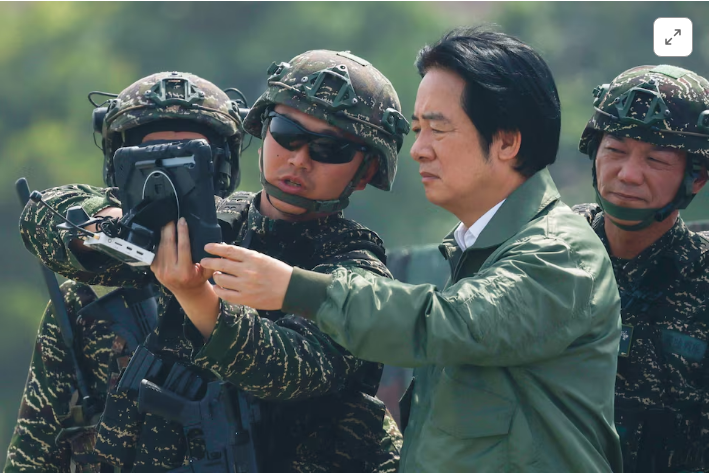
Taiwanese President Lai Ching-te personally supervised high-intensity coastal strike drills in the southern port city of Kaohsiung as the island nation launched its annual Han Kuang military exercises. The 10-day war games, representing Taiwan’s largest and most comprehensive defensive maneuvers, are designed to test real-world combat readiness, decentralized command structures, and rapid-response capabilities against a potential full-scale military invasion by China.
Boarding a high-speed fast-attack missile boat, President Lai observed live operational deployments featuring swarms of low-flying attack drones, anti-ship missile systems, and dual-use Coast Guard strike vessels. The exercise highlights a decisive shift in Taiwan’s defense posture toward asymmetric warfare—leveraging agile, distributed, and lethal counter-strike capabilities to deter cross-strait aggression.
Executive Summary of the Han Kuang Coastal Drills
- Command Supervision: President Lai Ching-te boarded an armed fast-attack missile craft in Kaohsiung to inspect littoral defense operations and test multi-branch command coordination.
- Operational Scope: The 10-day Han Kuang war games simulate a multi-phase defense against amphibious landings, aerial insertion, gray-zone harassment, and blockade scenarios.
- Asymmetric Assets: Heavy integration of low-flying strike drones, mobile anti-ship missile batteries, and stealth catamaran corvettes.
- Coast Guard Integration: Deployment of Anping-class Coast Guard patrol ships equipped with anti-ship missiles, reinforcing Taiwan’s “Second Navy” concept.
- Strategic Message: President Lai reinforced Taiwan’s commitment to bolstering self-defense capabilities amid growing external security threats while maintaining national sovereignty.
The 2026 Han Kuang War Games: Structure and Objectives
The Han Kuang exercises have served as the cornerstone of Taiwan’s joint military preparedness since 1984. However, the 2026 iteration marks a departure from traditional, heavily scripted war games of the past. Responding to evolving cross-strait dynamics, Taiwan’s Ministry of National Defense (MND) structured this year’s 10-day exercise to reflect unscripted, unannounced, and decentralized combat scenarios.
+-----------------------------------------------------------------------------------+
|                        2026 HAN KUANG EXERCISE STRUCTURE                          |
+-----------------------------------------------------------------------------------+
| Duration           | 10 Days of Unscripted, Island-Wide Live-Field Operations      |
| Core Focus         | Asymmetric Defense, Coastal Counter-Strike, Reserve Mobilization|
| Key Locations      | Kaohsiung, Tamsui River, Penghu Islands, Strategic Ports        |
| Operational Logic  | Decentralized Command, Civil-Military Defense Synergy            |
+-----------------------------------------------------------------------------------+
Key Phases of the 10-Day Defense Operations
- Gray-Zone Mitigation and Counter-Blockade Prep: Simulating responses to maritime militia intrusions, economic blockades, and coercive psychological operations designed to isolate the island.
- Force Preservation and Dispersal: Rapid repositioning of air, naval, and ground assets to underground shelters, hardened bunkers, and mobile concealment sites to survive initial missile strikes.
- Coastal Interdiction and Anti-Landing Operations: Concentrated coastal strike drills combining naval fast-attack craft, land-based missile units, and autonomous drone swarms to destroy adversary transport ships before beach insertion.
- Urban Resilience and Territorial Defense: Activating reserve units, establishing anti-vehicle barricades across major municipal centers, and securing critical infrastructure against decapitation strikes.
Inside the Coastal Strike Drill in Kaohsiung
During Saturday’s high-profile coastal strike phase in Kaohsiung, President Lai Ching-te observed firsthand the frontline implementation of Taiwan’s littoral warfare operations. Wearing military fatigue accessories, President Lai boarded a fast-attack missile boat navigating the tactical waters off southern Taiwan.
                    COASTAL DEFENSE KILL CHAIN

[ Satellite / UAV Surveillance ] ──> [ Decentralized Combat Command ]
                                                  │
                                                  ▼
     ┌────────────────────────────────────────────┴────────────────────────────────────────────┐
     │                                                                                         │
     ▼                                            ▼                                            ▼
[ Low-Flying Drone Swarms ]         [ Fast-Attack Missile Craft ]             [ Anping Anti-Ship Corvettes ]
(Target Disruption & Strike)        (High-Speed littoral engagement)           ("Aircraft Carrier Killers")
Drone Swarms and Autonomous Reconnaissance
A focal point of the Kaohsiung exercise was the synchronized deployment of small, low-flying attack drones. Operating over sea and beach zones, these unmanned aerial systems (UAS) demonstrated dual capabilities:
- Real-Time Target Acquisition: Relaying precision target coordinates of simulated landing craft back to mobile command centers.
- Kamikaze Swarm Attacks: Executing direct-impact strikes against high-value targets, disrupting enemy wave formations prior to shore reach.
The heavy emphasis on low-cost, expendable drone technology underscores lessons integrated from recent global conflicts, where unmanned systems have neutralized far larger conventional naval assets.
“Aircraft Carrier Killers”: The Role of the Anping-Class Corvettes
The 2026 exercises showcased the full integration of Taiwan’s Coast Guard Administration (CGA) into joint military strike plans. During Thursday’s drills preceding the Kaohsiung inspection, President Lai reviewed the installation of anti-ship missile launch systems aboard Anping-class Coast Guard catamarans.
+-----------------------------------------------------------------------------------+
|                  ANPING-CLASS COAST GUARD CATAMARAN SPECIFICATIONS                 |
+-----------------------------------------------------------------------------------+
| Vessel Platform    | Based on Tuo Chiang-class stealth missile corvette design     |
| Military Nickname  | "Aircraft Carrier Killer" due to heavy anti-ship payload      |
| Dual-Use Mission   | Peacetime: Maritime Law Enforcement / Search & Rescue         |
|                    | Wartime: Guided Missile Fast-Attack Strike Vessel             |
| Primary Weaponry   | Hsiung Feng II and Hsiung Feng III Anti-Ship Cruise Missiles  |
+-----------------------------------------------------------------------------------+
The “Second Navy” Operational Model
Based on the navy’s Tuo Chiang-class stealth warships, the Anping-class vessels are engineered with wave-piercing catamaran hulls that provide high speed, stability, and a reduced radar cross-section.
In peacetime, these vessels perform fisheries protection and maritime patrol. However, in times of war, they are rapidly converted into combatants fitted with supersonic Hsiung Feng III anti-ship missiles. Capable of hitting surface targets at high speeds, these vessels are designed to punch well above their weight class, giving rise to their moniker as “aircraft carrier killers.”
Taiwan’s Asymmetric Warfare Pivot: The “Porcupine Strategy”
The operational mechanics demonstrated in the coastal strike drills reflect Taiwan’s strategic transition toward the “Porcupine Strategy” (or Overall Defense Concept). Rather than attempting to match China’s People’s Liberation Army (PLA) item-for-item in conventional platforms like heavy destroyers or strategic bombers, Taiwan is prioritizing asymmetric tools that are highly mobile, survivable, and cost-effective.
CONVENTIONAL DEFENSE PARADIGM              ASYMMETRIC "PORCUPINE" STRATEGY
-----------------------------              -------------------------------
Large Capital Warships                     Fast-Attack Missile Boats & Corvettes
Fixed Air Defense Radar Stations           Mobile, Concealable Missile Launchers
Fixed Coastal Artillery Units              Autonomous Strike & Recon Drones
Centralized Command Hubs                   Decentralized, Networked Tactical Cells
Core Elements of the Asymmetric Model
- Mobility and Concealment: Replacing fixed defensive positions with truck-mounted missile launchers that can fire and immediately relocate to hidden positions across coastal terrain.
- Layered Interdiction: Engaging invading forces at long ranges with anti-ship missiles, at medium ranges with sea mines and fast-attack craft, and at short ranges with coastal artillery, portable anti-tank weapons, and drone swarms.
- Decentralized Command: Empowering lower-level tactical commanders to initiate strikes independently if central communications are disrupted by electronic warfare or cyberattacks.
Comparative Analysis: Defensive Postures in the Taiwan Strait
| Feature / Metric | Traditional Defense Model | Current Asymmetric “Porcupine” Model |
| Primary Naval Assets | Large destroyers and frigates | Fast-attack boats, stealth catamarans, unmanned sea drones |
| Air Defense Strategy | High-cost jet fighter patrols | Integrated land-based surface-to-air missiles (SAMs) |
| Coastal Interdiction | Stationary shore batteries | Mobile anti-ship missile trucks (Hsiung Feng, Harpoon) |
| Command Architecture | Highly centralized command hubs | Decentralized, resilient operational nodes |
| Civilian Integration | Limited to standard logistics | Active reserve mobilization and urban defensive barriers |
Political and Geopolitical Context: President Lai’s Address
Speaking directly to naval personnel, coast guard officers, and military commanders aboard the missile boat, President Lai Ching-te stressed that the overriding purpose of the Han Kuang drills is to safeguard national sovereignty and ensure peace through strength.
“The purpose of the Han Kuang exercises is to test our command coordination, operational responsiveness, and homeland defense capabilities using real troops and live terrain. Facing external challenges and growing security threats, our government will continue to enhance our defense capabilities, providing the strongest support to our armed forces and Coast Guard.”
— Taiwan President Lai Ching-te
Strategic Ambiguity and Beijing’s Response
While President Lai carefully avoided referencing Beijing by name in his official address, the drills are unambiguously structured around countering PLA invasion scenarios. Beijing regards Taiwan as a breakaway province and has repeatedly refused to rule out the use of military force to achieve unification.
Chinese state officials view President Lai as a “separatist” and have routinely rejected his repeated invitations for bilateral dialogue on equal footing. In response to past Taiwan military exercises, Beijing has frequently conducted large-scale combat readiness patrols and encirclement drills around the island, utilizing aircraft and naval vessels to apply psychological and operational pressure.
Homeland Defense, Reserve Mobilization, and Civil Resilience
Beyond maritime and air engagements, the 2026 Han Kuang exercises place unprecedented emphasis on civil defense and reserve readiness.
+-----------------------------------------------------------------------------------+
|                        HOMELAND RESILIENCE FRAMEWORK                              |
+-----------------------------------------------------------------------------------+
| Military Reserves   | Rapid mobilization of reservist brigades for urban defense  |
| Infrastructure      | Hardening energy grids, telecom nodes, and water supplies   |
| Civil Response      | Coordinating local police, fire services, and evacuation   |
| Urban Fortification | Deployment of temporary obstacles across critical transit corridors|
+-----------------------------------------------------------------------------------+
Urban Fortification and Anti-Landing Operations
Throughout key coastal provinces and metropolitan centers, military units executed overnight defensive maneuvers:
- Bridge and Port Security: Setting up heavy anti-vehicle obstacles, wire barriers, and anti-tank barricades to seal off key transit corridors connecting port landing zones to major urban areas.
- Riverine Defense: Simulating counter-landing operations along the Tamsui River in northern Taiwan, preventing hostile amphibious forces from penetrating deep into the capital region.
- Outlying Island Defense: Executing live-fire artillery and anti-air exercises on Taiwan’s outer islands, including Penghu and Kinmen, to counter initial airborne and sea-landing attempts.
Global Impact and Indo-Pacific Security Implications
The stability of the Taiwan Strait is not merely a regional issue—it is a critical pillar of global trade and international security.
1. Global Semiconductor and Tech Supply Chains
Taiwan produces over 60% of the world’s advanced semiconductors and over 90% of the highest-end microchips through giants like TSMC. Any military confrontation or sea blockade would cause immediate, catastrophic disruptions to global technology manufacturing, automotive production, and consumer electronics markets worldwide.
2. Commercial Maritime Transit
The Taiwan Strait serves as one of the world’s busiest maritime transit routes for container ships and bulk carriers traveling between East Asia, North America, and Europe. Prolonged conflict or military exclusion zones in these waters would force global shipping lanes to re-route, pushing global freight rates to record highs and destabilizing energy distribution.
3. Regional Security Alliances
The live drills in Taiwan occur alongside heightened defense cooperation across the Indo-Pacific region. Nearby nations, including Japan, the Philippines, and Australia, alongside the United States, have continually monitored cross-strait military balance, emphasizing that peace and stability in the Taiwan Strait are essential to a free and open Indo-Pacific.
Strategic Outlook and Key Takeaways
Taiwan’s 2026 Han Kuang exercises signal a mature, realistic, and highly resilient approach to national defense. By combining fast-attack missile boats, stealth Coast Guard corvettes, low-flying strike drones, and decentralized command structures, Taiwan is building a formidable, multi-layered defensive shield.
President Lai Ching-te’s direct oversight of the Kaohsiung coastal strike drills highlights Taiwan’s resolve to maintain operational readiness in the face of continuous external threats. As the 10-day war games progress, Taiwan’s military continues to demonstrate that deterrence rests not on the sheer size of an armed force, but on the ability to deliver swift, decisive, and asymmetric responses to protect sovereignty and democratic freedom.
Read more Shocking News here