The government has told the Supreme Court it is open to stricter red warning labels on packaged food — a move that could reshape how India’s $100 billion food industry talks to its consumers.
Picture This
You’re standing in a supermarket aisle, reaching for a bag of chips, a bottle of soft drink, or a box of your child’s favourite breakfast cereal. Right now, the nutrition information on that pack is a maze of numbers — grams of sugar, salt, and fat tucked away in fine print on the back.
Soon, that could change dramatically.
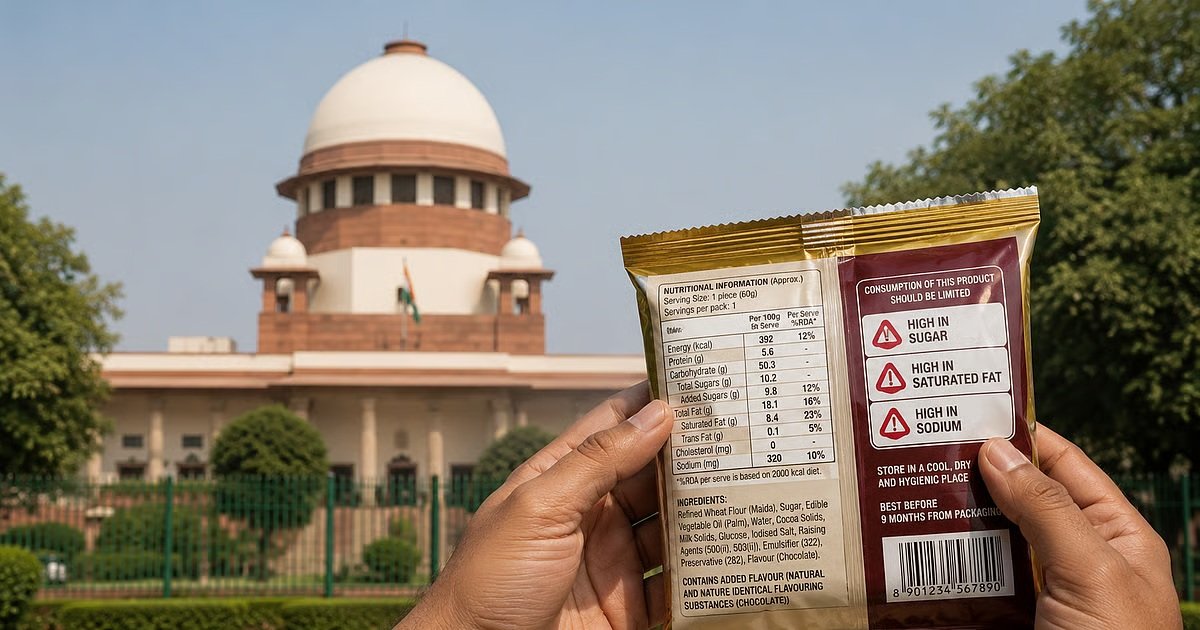
Instead of decoding a nutrition table, you might simply glance at the front of the pack and see a bold, red hexagon — an unmissable signal that the product is high in sugar, salt, or fat. No math, no guesswork. Just a warning, right there, before you even pick it up.
That’s the future India’s food regulator is now edging toward — and the Supreme Court is the stage where the final shape of this warning is being decided.
What Just Happened?
On Thursday, September 10, 2026, India’s government told the Supreme Court that it is willing to consider stricter red warning labels on packaged food — a significant shift after health activists criticized the regulator’s original proposal as too soft on the industry.
Here’s the sequence of events that brought us here:
Quick Question for You: Before reading on, take a guess — do you think a product should be flagged with a warning label if it’s high in just one of three things (sugar, salt, or fat), or should it need to cross the limit on at least two? Keep your answer in mind as you read what the regulator originally proposed, and how the Court pushed back.
The Timeline So Far
📅 July 2026 — The Supreme Court directed the Food Safety and Standards Authority of India (FSSAI) to implement front-of-pack nutrition labelling, ending years of delay on the issue.
📅 August 28, 2026 — FSSAI proposed a two-phase system:
- Phase 1: A red hexagonal warning label would apply only to products exceeding limits in at least two of three categories — added sugar, salt, or saturated fat.
- Phase 2: Stricter norms would follow later, with no firm timeline attached.
📅 Early September 2026 — Health experts and activists pushed back hard, arguing that the “two-nutrient” trigger created what they called an “industry-friendly loophole.” Their concern: a product could be dangerously high in sugar alone, for instance, and still escape a warning simply because it wasn’t also high in salt or fat.
📅 Same week — The All India Food Processors’ Association (AIFPA) — representing major players like Nestlé, Coca-Cola, PepsiCo, and Hindustan Unilever — filed its own challenge in the Supreme Court, asking for further scientific scrutiny of the proposed thresholds before anything is implemented.
📅 September 10, 2026 — During the hearing, Justice J.B. Pardiwala pointedly questioned the regulator’s phased approach, asking why a product would need to breach limits on sugar and salt before a label kicked in. Following the Court’s observations, the Additional Solicitor General representing FSSAI indicated the authority could roll out both phases together — meaning a product high in even one of the three nutrients could carry a red warning label.
Why This Fight Matters — To Everyone
This isn’t just a regulatory technicality. It sits at the intersection of public health, corporate interests, and consumer rights — and the stakes are enormous on every side.
🏥 The Public Health Case
India is grappling with a rising burden of lifestyle-related illness. Health advocates argue that:
- A large share of deaths in India are linked to lifestyle factors, including poor diet.
- Clear, unavoidable warning labels have worked elsewhere — countries like Mexico saw meaningful drops in obesity rates after adopting similar front-of-pack warnings.
- The “two-nutrient” threshold could let a worrying number of ultra-processed products slip through unlabeled.
🏭 The Industry Case
Packaged food companies, through AIFPA, argue that:
- The thresholds need more rigorous scientific validation.
- Rules should be internationally consistent while still reflecting Indian dietary patterns.
- A one-size-fits-all trigger could unfairly flag products that aren’t necessarily “unhealthy” in context.
⚖️ The Court’s Role
The Supreme Court is currently hearing a public interest litigation filed by a health group, alongside the industry’s separate challenge — putting both sides of the argument directly in front of the judges who will help determine what final shape these rules take.
Test Yourself: Would Your Favorite Snack Get a Red Label?
Here’s a fun (and slightly unsettling) exercise. Think of three packaged snacks you regularly buy — a namkeen, a soft drink, a packet of biscuits. Now ask:
- Would it likely exceed limits on added sugar?
- Would it likely exceed limits on salt?
- Would it likely exceed limits on saturated fat?
If you answered “yes” to even one, under the framework now being discussed, that product could soon be wearing a bright red hexagon on its front — impossible to miss, impossible to ignore.
The Bigger Picture: A Crackdown Beyond Labels
This labelling battle isn’t happening in isolation. It comes amid a broader, aggressive food-safety enforcement drive across India:
- Nationwide raids on eateries have uncovered hygiene violations, leading to a wave of closures.
- Regulators have reportedly tested well over 100,000 food samples annually since 2020, with roughly one in five found unsafe, substandard, or improperly labelled.
- Thousands of food-business licences have been cancelled in the past three years alone.
Consumer anger over food safety has been building — and the labelling debate has become a lightning rod for that broader frustration.
What Happens Next?
The Supreme Court’s continued hearings will likely determine:
| Open Question | What’s at Stake |
|---|---|
| Single vs. dual nutrient trigger | How many products actually get flagged |
| Timeline for implementation | Whether Phase 2 arrives soon — or gets delayed indefinitely |
| Scientific basis for thresholds | Whether industry’s demand for “further examination” slows things down |
| Final label design | Whether the red hexagon becomes India’s version of a global front-of-pack warning standard |
For now, the government’s openness to stricter labels marks a notable shift — a signal that the Court’s scrutiny is nudging policy in a more consumer-protective direction, even as industry pushes back through the same judicial process.
The Takeaway
Whatever the Supreme Court decides, one thing is clear: the humble food label is becoming a genuine battleground — between what companies want to say, what regulators are willing to mandate, and what health advocates believe consumers deserve to know before they take a single bite.
The next time you’re in that supermarket aisle, that red hexagon — or its absence — may end up telling you more than any nutrition chart ever did.
This article is based on court proceedings and regulatory developments reported as of September 10, 2026. As this is an active, evolving legal matter before the Supreme Court of India, further hearings and regulatory notifications may alter the final framework.
Read more trending news here